Friday, February 19, 2021

A Statistical Interlude

 In our initial Discovery phase, we added some questions to our case recording system (Casebook) so that we could gather data on our client's internet usage.  As the discovery stage was quite a short process, we were only able to get a handful of results which could have meant that any outliers would have a bigger skew on our data.

With that in mind, we have continued to ask these questions to clients ringing our telephone adviceline over a period of months (October 2020 - February 2021), and now have a dataset of 568 entries from different clients.

The questions we asked were:

Do you have regular use of the internet?

and 

If so, what do you use it for?

In addition to these extra questions, we always record client profile information when advising somebody for our own records and to satisfy our funders.  As the internet questions were recorded alongside the client profiles, we are able to cross reference this data to gain a better understanding of how internet usage differs across our client base.

As we don't always record every category in a client profile (as some people may have declined to answer), the totals for each category are different.  As these results are displayed as percentages, we have also removed or combined any answers with very small numbers so as not to wrongly represent any outliers.

Do you have regular use of the internet?

Without any breakdown of client profile, we can see that regular usage of the internet seems quite high (74%) amongst our clients, but is considerably lower than the Internet User Penetration Rate in the UK (2020) of 95.53%.  This may partly be explained by our use of the words "regular usage" in our question which may eliminate some people who have internet access but use it infrequently.

Broken down by age range, we can see a clear decline in regular internet usage as people get older.
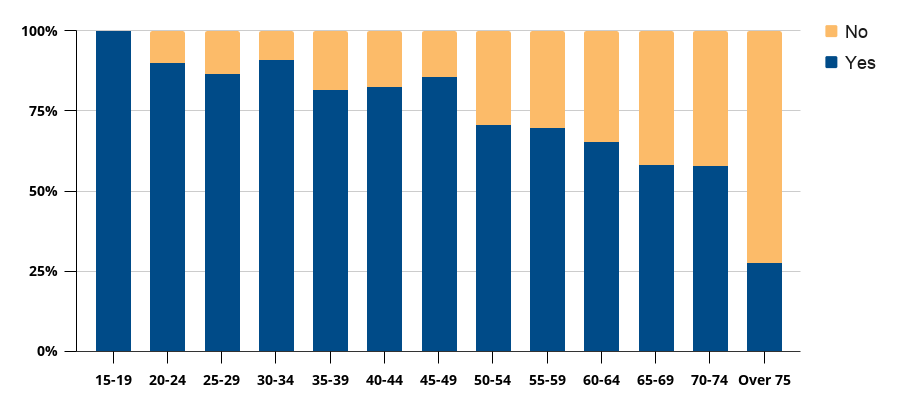
Clients with a disability or long-term limiting illness are considerably less likely to be regular internet users.

Regular internet usage is considerably lower for clients with no children, than those with children (particularly those with dependant children).


Interestingly, regular internet usage was higher at both ends of the scale for income per calendar month, with the dip in usage for people with an income of £600-£799 pcm.


Finally, we looked to see if regular internet usage changed based on client's location.  The darker areas show where a higher percentage of clients regularly used the internet.


If so, what do you use it for?

Our second question was left open-ended, so attracted a range of replies. The word cloud below showsthe wider range of responses (the bigger words were used more to describe internet usage).

To make this data more manageable, we have grouped it together into various areas of internet usage.  The graph below shows each area, and the number of clients who identified it as something they use the internet for.

Although general, there are some areas clearly ahead of the others, Communication, Shopping, Social Media and Information.  Although communication included emails and webchat, nobody specifically mentioned video calls, further showing that it may not be as popular channel as we were originally expecting.

Breaking these areas down by the client's age, we can see that those four are still the most used regardless of age range.  What can be seen clearly though, is that older age ranges have a smaller breadth of internet usage.

The table below shows the areas of usage, broken down by age range.  The numbers are the percentage of usage within each age range.  The heatmap shows a higher percentage of usage in green, and a lower percentage of usage in red. This clearly shows how different age groups interact with the internet.


Thursday, February 18, 2021

How It Started... How It’s Going

We started this project in 2020, a year of lockdowns, social distancing, change and toilet roll shortages, but for us a year of "discovery".

As lockdowns closed offices, cutting off our main points of contact, we had moved our focus to what we could still offer, namely telephone advice.  We were able to increase the coverage and operational hours of our adviceline to meet a shifting demand but we wanted to know if we could do more.

We revived a webchat feature to our website, increased our social media output, installed a freephone telephone outside our office and even erected a gazebo in Tesco's car park for the hardy souls still venturing outdoors.

The world seemed to have adapted to video calling in such a short time, with internal video calls replacing poking your head through the office door to chat to a colleague (albeit with the reduced chance of being able to swipe a biscuit from their desk).  Judging by the media, everybody seemed to be constantly in Zoom meetings, whether for work, connecting with family, taking part in an exercise class or a TV broadcast. But were they really, and was this something we could utilise for advice?

Our discovery phase started with a problem, or more specifically, a "problem statement", an issue we wanted to address.

Maximising access to and the services we offer for potential and current clients in order to improve more people's lives

We spoke directly to the people that matter most to us, our clients. Our consultation consisted of calling a small number of clients and asking them about using technology to expand our reach.

  • Most of the clients (7/9) had regular access to the internet and used a range of devices for information finding, communicating with family, email, social media, online banking etc.  
  • The majority of clients who used devices other than a landline said that their preference was to use a smartphone for internet access.
  • Clients described a good service as one that was ‘responsive’, ‘individualised’ and where they were treated with ‘empathy and care’. 
  • It was important for people that Citizens Advice was able to give them correct and up to date information and advice that they could be confident of plus a way forward with their issue.  Having a caring, patient and kind adviser was critical to the client’s experience.

One of the main points that came from this consultation was that our clients mainly used the internet for more general purposes (browsing, searching for information, form filling, social media) and most would not have been happy to get advice over video.

We also added a number of questions to our Case Recording system (Casebook) to help us capture more information about our client's internet usage.  At this stage of the discovery phase, we only had a handful of results to analyse.  Since then, we have continued to ask this question over a period of months and will share these enhanced findings in a later blog post.

We then spoke to the group of people who know our clients best, our advisers.  This survey also highlighted potential issues with video advice.

A lot of clients would struggle with the technology. Privacy for some clients may be an issue. Also if they are not used to video calling they may feel uncomfortable with it.

I feel that the boundary between work and home is already blurred. My feeling is that having a face to face consultation with a client in my home would feel intrusive to me. I am not clear what benefit the video call would bring as accessing paperwork and supporting documents would still not be possible.

I hate being seen on video calls. 

It became clear to us that although there would be a few people interested in using a video advice line, the costs and technological hurdles wouldn't be worth investigating when it could cause issues for people.  We take privacy and security very seriously and wouldn't want our advisers feeling uncomfortable video calling from their own homes or for anybody to feel uneasy handling technology that wasn't adding much to what we can achieve in a phone call.

Whilst we didn't discover what we expected to, it was still an important discovery.  We stopped heading down a route that may not have been a benefit to clients, and may have been a detriment to our advisers.  We had moved on from "we don't know what we don't know" and onto "we know what we don't need".

Before moving into the second phase of this project (Definition), we shifted our focus onto an online tool we already had.  This was already a "minimum viable product" in that we already had it, and it worked.  But it was something that we wanted to update, expand upon and improve.  Learning from the lessons of the Discovery phase, we knew we needed to talk to people first and so we entered a new consultation phase on our money advice and budgeting online tool, CABmoney.